This is a list of festivals held within Morocco

List of festivals in Morocco

  • Arts in Marrakech (AiM) International Biennale
  • Atlas Electronic
  • Candles Convoy of Salé
  • Gnaoua World Music Festival
  • International Film Festival of Marrakech
  • Mawazine Music Festival
  • Merzouga International Music Festival
  • World Sacred Music Festival
  • Imilchil Wedding Festival
  • Sefrou cherry festival
  • Traditional music styles

    Aita

    Aita (عيطة “call, cry or lament”) is a popular Bedouin musical style that originates from the countryside of Morocco, especially the Atlantic plains—areas such as Doukkala-Abda, Chaouia-Ouardigha, and Rehamna.

    Amazigh folk music

    There are many varieties of Berber folk music and dance, such as Rif, Kabyle, Atlas, Chawia, and Canaria.

    Ahwash
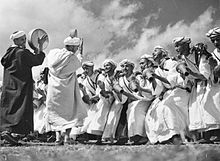
    Ahwash in the High Atlas in 1955.

    Ahwash (أحواشⴰⵃⵡⴰⵛ) is a collective musical form associated with Amazigh communities in southern Morocco, particularly around Ouarzazate, the Dra’a Valley, and Sous.[2] Ahwash involves dance, singing, poetry, and percussion.

    Ahidus
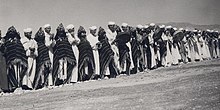
    Ahidus in 2002.

    Ahidus (أحيدوسⴰⵃⵉⴷⵓⵙ) is a style of collective dance and song of the Amazigh tribes in Middle and Eastern High Atlas.

    Guedra

    Guedra is a music and dance style associated with the Tuareg “blue people” of the Moroccan sahara.[3] The name comes from an earthen cookingware over which a hide is stretched to form a drum.[4]

    In 2021, the anthology of the art of “Rrways – a journey into the realm of Amazigh wandering poet- singers”, presenting a booklet and ten compact discs with current recordings received the ‘ Prix Coups de Cœur – Musiques du Monde’ of the Académie Charles Cross in France.[5]

    Andalusi classical music
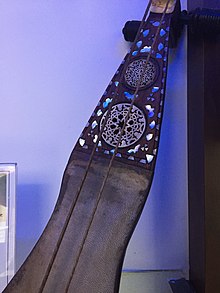
    A rebab on display at Dar al-Aala, a museum and conservatory dedicated to Andalusi musical heritage located in Casablanca.

    For the music of Andalusia, Spain, see main article: Music of Andalusia

    Andalusi classical music (Arabic: طرب أندَلُسي, موسيقى الآلة transliterated ṭarab andalusi or Musiqa al-Ala, Spanish: música andalusí) is a major genre of Arabic music found in different local substyles across the Maghreb (Morocco, Algeria, Tunisia, and Libya in the form of the Ma’luf style). It originated in the music of Al-Andalus (Moors) between the 9th and 15th centuries.

    Some of its lyrics are based on poetic works written by authors from Al-Andalus, such as Al-Shushtari, Ibn al-Khatib and Al-Mu’tamid ibn Abbad. Andalusi music is considered part of the longest traditions of art and music in the world. Andalusi music was greatly influenced by Ziryab, a freed Persian slave and musical pioneer, in the early 9th century. After Ziryab’s death, two new styles of poetry were introduced in Al-Andalus: Muwashshahat and Zajal.[6]

    Chaabi “popular” folk music[edit]

    Chaabi (Arabic: الشعبي, meaning popular in English) is a music consisting of numerous varieties which descend from the multifarious forms of Moroccan folk music. Chaabi was originally performed in markets, but is now found at any celebration or meeting.

    Raï Music

    Morocco has produced its own stars like Cheb Mimoun and Hanino. Rai music originated from Algeria, but is just as effective and popular in Morocco. This style of music was created during a period of political turmoil, and served a purpose of social and political commentary. Rai music has gained massive support over the years from the urban populace for its purpose of addressing taboo topics.[7] It was also greatly known for code switching between French and Arabic. Rai artists use this method to add to the rhetorical and aesthetic effect of the lyrics, as well as a method of opening the lyrics to a wider range of an audience.

    Gnawa music
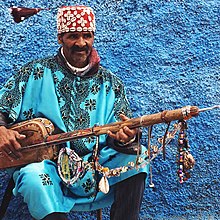
    A gnawa street performer wearing traditional gnawi clothing in Rabat’s Qasbat al-Widaya.

    Gnawa music is a mystical form of music and incantation of West African origin. It was initially brought to Morocco by Sub-Saharan Africans and gradually became part of the Moroccan musical tradition. The gnawa musicians are respected for their spiritual performances. Through oral traditions, they have handed down a specific cultural ceremony, called derdeba or lila, which consists of song, dance, the burning of incense and of specific costumes and colours. The instruments used are large drums called “tbel” or “qanqa” and metal double castanets called “garageb”. The main instrument is a three-stringed bass lute, called the “gimbri” accompanied by the chanting of the singers.[8]

    Classical Malhun

    Classical Malhun is peaceful music associated with urban centers such as Meknes, Fes, Salé, Tetouan, and Oujda. It has been played around in the streets of Morocco for over a thousand years. It is very common music to hear in Morocco.

    Classical Sufi music

    Sufi brotherhoods (tariqas) are common in Morocco, and music is an integral part of their spiritual tradition. This music is an attempt at reaching a trance state which inspires mystical ecstasy.

    Recent styles

    Funk

    Attarazat Addahabia was one of the pioneers of funk music in Morocco.[9] Jil Jilala was also influential in this genre.

    Rock

    Nass El Ghiwane, led by Larbi Batma, was an icon of Moroccan music in the late 20th century.

    Hoba Hoba Spirit is a rock band that draws influence from traditional Moroccan styles such as gnawa, as well as styles from abroad such as reggae.

    Bab L’ Bluz combine Gnawa music with various influences such as blues and psychedelia to embody the “Nayda” movement among young people in Morocco.

    Hip-hop

    Notable Moroccan hip-hop musicians include El Grande Toto, Don Big, 7liwa, and others. Among the younger generation there are Issam and Manal Benchlikha.

Festivals in North Macedonia

Film

  • Manaki Brothers Film Festival

Music

  • Balkan Music Square Festival, a music festival
  • International Children’s Music Festival “Asterisks”, an international children’s festival
  • Ohrid Summer Festival, an annual theater and music festival from July to August
  • Skopje Jazz Festival, a jazz festival
  • MakFest,
  • Ohrid Choir Festival, a choir festival
  • Ohrid Fest,
  • Skopje Fest,

Folklore and traditional

  • Balkan Festival of Folk Songs and Dances, annual folklore music and dance festival
  • Galičnik Wedding Festival, an annual festival held in Galičnik in which a selected couple gets married in the traditional “Galička” style wedding

Children’s

  • Si-Do, a children’s festival

Theater

  • Struga Poetry Evenings, an internationally acclaimed poetry festival
  • Days of Comedy, a theater comedy festival in Kumanovo

Sports

  • Ohrid Swimming Marathon, an international open water swimming competition in Lake Ohrid

Holidays and festivals in Laos

Notable festivals and public holidays

  • Boun Bang Fay (ງານບຸນບັ້ງໄຟ)
  • Boun Fai Payanak
  • Boun Haw Khao Padap Din (ງານບຸນຫໍ່ເຂົ້າປະດັບດິນ)
  • Boun Khao Pansa(ງານບຸນເຂົ້າພັນສາ)
  • Boun Khun Khao
  • Boun Makha Busaa
  • Boun Ok Pansa
  • Boun Suang Huea
  • Boun That Luang
  • Boun That Sikhot
  • Boun Wat Phu Champasak
  • Chinese New Year/Tết
  • Hmong New Year
  • International Labor Day
  • Lai Heua Fai
  • Lao Children’s Day
  • Lao Elephant Festival
  • Lao Independence Day
  • Lao Issara Day
  • Lao New Day
  • Lao Women’s Day
  • Pi Mai Lao
  • Ok Phansa
  • Pathet Lao Day
  • That In Hang Festival
  • Vixakha Bouxa

Japanese festivals

Film festivals

 
Festival name Type City/venue Years Notes
Asian Queer Film Festival Film festival Tokyo
CON-CAN Movie Festival Film festival Tokyo
Hiroshima International Animation Festival Film festival Hiroshima
Image Forum Festival Film festival Tokyo
Mainichi Film Awards Film festival Tokyo
Okinawa International Movie Festival Film festival Ginowan & Naha,
Okinawa Island
Tokyo Filmex Film festival Tokyo
Tokyo International Film Festival[1] Film festival Tokyo
Tokyo International Lesbian & Gay Film Festival Film festival Tokyo
Yamagata International Documentary Film Festival Film festival Yamagata
Yokohama Film Festival Film festival Yokohama
Yubari International Fantastic Film Festival Film festival Yūbari,
Hokkaido

Music festivals

 
Festival name Type City/venue Years Notes
Yamaha Popular Song Contest Pop festival Kakegawa 1969-1986 Music contest and festival
B-Boy Park Hip hop festival
Concert on the Rock Rock festival
Cosquín en Japón Folk festival
Firefox Rock Festival Rock festival
Fuji Rock Festival Rock festival
Heart-Aid Shisen Rock festival 2008
Live under the sky Rock festival
Loud Park Festival Heavy metal festival
Mount Fuji Jazz Festival Jazz festival
Naon no Yaon Rock festival Hibiya Open-Air Concert Hall 1987–1991, 2008, 2013–present Exclusively female performers
Newport Jazz Festival in Madarao Jazz festival
Rising Sun Rock Festival Rock festival
Rock in Japan Festival Rock festival
Saito Kinen Festival Matsumoto Classical music festival
Songs Day Pop festival
Summer Sonic Festival Rock festival
Tokyo Music Festival Pop festival
Yamaha Music Festival Classical music festival

This is a list of regular festivals and events in the Isle of Man, both traditional and recently established.

Traditional annual events

The Isle of Man is a Celtic nation, and as such there are close correspondences to Irish and Scottish festivals.

Event Manx Gaelic name Date Notes
Beltane (May Day) Boaldyn 1 May Traditional Celtic celebration of the return of summer
Tynwald Day Laa Tinvaal 5 July
(usually)
Annual open-air promulgation of the laws
Mhelliah Sept–Oct Harvest festival
Samhain Sauin 31 Oct–
1 Nov
Traditional Celtic celebration of the beginning of winter
Oie Houney = “Night of Sauin”
Halloween Hop-tu-Naa More recent celebration of Halloween/Sauin
Hunt the Wren Shelg y Drean 26 Dec St. Stephen’s Day

Modern sports events

Event Notes
Motor cycling and motor racing
Tourist Trophy (TT) The most famous and important event on the island.
International VMCC TT Rally Held during TT Week. It is a motorcycle event that lasts six days and is organised to take place on non-race days.
Douglas Beach Race This motorcycle race is held on Douglas Foreshore during TT week. The bikes race over huge man-made sandcastles.
Ramsey Sprint The Ramsey Sprint has been run since 1978 and is one of the biggest events outside the T.T. races.
Formula 2 Stockcar Manx Open F2 TT The stockcar racing is a contact motorsport where the more experienced drivers start at the rear of each race. They have a set number of laps to make their way to the front, using their bumper to push their opponents aside.
The Manx Two Day Trial The Manx National Two Day Trial is for solo and sidecar competitions. The event covers all areas of the Island over two days. The event caters for modern and older machinery. One of the biggest and best Trials in Europe with two full days of Off Road endeavour.
The VMCC Manx Rally A week of events for vintage motorcycle enthusiasts, centred on the Manx GP Week.
Coastal events
Round the Island Yacht Race Held on 4 May 2008. A large event that is held every year. They race anti-clockwise around the island. Although this is a competitive sport there is also a full social programme. The participants compete for a chance to win a trophy but also to be awarded PY handicap points.
Ramsey Angling Festival Includes a series of beach fishing competitions held over the weekend. Held annually.
Mannin Angling Club Festival The event consists of two shore and five boat fishing competitions. Boat competitions are classed in two categories: private and charter.
Other sport events
Crown Green Bowls Festivals During the events calendar there are two bowls competitions: the June Festival and the September Festival.
Parish Walk Long-distance walking event visiting all 17 historic parishes of the island
Isle of Man Dance Festival
Manx Mountain Marathon A 31-mile fell race from Ramsey to Port Erin. The course is mostly on fells and country and visits all the major hill summits. The race is one of athletics ultimate challenges covering difficult, rugged terrain as it visits the Isle of Man’s major peaks.
Isle of Man Easter Athletics A three-day festival of athletics held at various places on the island over the Easter weekend. The event attracts adult competitors of all abilities from clubs and heavily from universities throughout the UK. A 10k road race is held on Good Friday, Peel Hill Race on Easter Saturday and a 4 × 5k road relay on Douglas Promenade on Easter Sunday. The event culminates with the prize presentation and a party on Easter Sunday Evening.
IOM Sports Club Challenge A series of sporting events aimed at club members, not elite players. The S.C.C.S now incorporates the student weekend and up to two other events (netball + squash). The number of sports may expand in the future.
Isle of Man Marathon and half Marathon Races The full marathon and half marathon road races – on a quiet, scenic and rural course – starting and finishing in Ramsey.
NBC Basketball Camp A week-long event providing basketball and life skills coaching for ages 10 to 19.

Other events

Event Notes
Isle of Man Queenie Festival A celebration of the sea.[clarification needed] Usually held over 3 days in Port Erin and Port St Mary.
Spring Darts Festival The Isle of Man’s International Darts Festival is held annually. More than 800 competitors took part in last year’s[clarification needed] event.
Manx Model Meet Gathering of model aircraft flyers for a club event on Jurby airfield.
Isle of Man Bridge Congress A duplicate bridge competition which forms part of the English Bridge Union’s calendar of events.
IOM Chess Tournament An international chess event attracting top chess players from all over the world. Held annually in Port Erin from 1992 to 2007. It resumed in 2014 and since then has been held annually in Douglas.
Isle of Man Festival of Pool – British Open Would[clarification needed][Does this mean it never happened?] see pool players of all ages, male or female and from all parts of the UK and Ireland as well as players from France, Spain and other European countries attending the festival.
Manx Model Boat Festival
IOM International Jazz Festival
Mananan International Festivals An annual festival of music and arts founded in 1975, held in the Erin Arts Centre. The main festival is held in June and the opera festival in September.
Braaid Eisteddfod An annual musical and literary festival that has been held at the Braaid since the 1950s.

References

Iranian festivals

  • Noroozno means new and the word rooz means day, so Norouz means starting a new day and it is the Celebration of the start of spring (Rejuvenation). It starts on the first day of spring (also the first day of the Iranian Calendar year), 21 March, in that 12 days as a sign of the past 12 months, all Iranian families gather around and visit each other. It is also the best time to re-experience the feeling of mehr (pure love). In Norouz all families talk about their best experiences of the last year and the things they are looking forward in the next year and they all become bonded again in peace. There are many other things Iranians do for nowruz including khane tekani (cleaning the house) and haji firooz, where a person who makes his face black and wears a red dress, walks around the streets and entertains people by singing a special song.

Haft Seen traditional table of Norouz

  • Sofre-ye Haft-Sin: sofre (tablecloth), haft (seven), sin (the letter S [س]). Al-Bīrūnī said: Haft-sin came from Jamshid since he destroyed the evil that made Persian lands weak, so in first day of Iranian calendar people celebrated Norouz and they put 7 different symbolic items on their table as a sign of thanking nature for giving humans all they need. Since then every year Iranians put Haft-sin on their tables, but nowadays they put 7 things that start with letter “S (س)”. Some people also believe that Sasanians had a very beautiful plate that was given to them from China and they called it chini plate, and after some years the word chini changed into sini (a beautiful plate) so people would put 7 things in a sini.
  • Sizdah Bedar: Persian Festival of “Joy and Solidarity”. The 13th and last day of Norouz celebration. Because of the end of twelve days (a sample of twelve month) they celebrate the 13th day as a new beginning of the next twelve month and it has no relations with the number 13 (as an unlucky number). It is celebrated outdoors along with the beauty of nature. Al-Bīrūnī also called this day: tir ruz: blissed day.
  • Mehregan: Festival of Mehr (or Mihr=MIthra). A day of thanksgiving. It is a day which everyone show the mehr or the love they have for each other and it is one of the most important days in the year.
  • Jashn-e Sade: A mid-winter feast to honor fire and to “defeat the forces of darkness, frost and cold” in which people gather around and build a fire so that they can receive good things from the fire and give the fire their incompleteness.
  • Shab-e Yalda: Also known as The turning point. End of the longest night (darkness) of the year, and beginning of growing of the days (Lights). A celebration of Good over Evil. Also known as they have special nuts for that night.
  • Sepandarmazgan: Day of Love, Friendship and Earth in ancient Persian culture.
  • Chaharshanbe Suri: Festival of Fire, last Wednesday night in the Iranian Calendar year. It marks the importance of the light over the darkness, arrival of spring and revival of nature.

Zoroastrianism

The basis of nearly all of Iranian national festivals are from its Pre-Islamic Zoroastrian era. However, there are some festivals that are celebrated exclusively by Zoroastrians and some with less extent in other communities too.

  • Khordadgān: Celebration of the 6th day of Iranian calendar. Khordad is one of the Izadans name which means completeness. In this day people used to go near the river or a sea to thank God for everything and they gave each other flowers as a sign of happiness.
  • Bahmanagān: Also maintained by Iranian Muslims until the Mongol invasion. The festival was celebrated on the second day of the month of Bahman. Bahmanjana is a later modified form of Bahmanagān.
  • Sepandarmazgān: Esfandegān or Spandegān is the day of love.
  • Farvardingân: Festival of the Forouhar .
  • Jaşne Sade: Festival of Fire. Lit. the 100th day (before Nowruz).
  • Jaşne Mehregân: Festival of Mihr (or Mehr). A day of thanksgiving dedicated to the highest Angel, Mithra (c.f. Metatron).
  • Jaşne Tiregân: Festival of Tir. A day dedicated to Tishtrya, Angel of the star Sirius and rain. Also celebrated in some Muslim regions in Iran including Mazandaran.
  • Nowruz: New Year’s Day. March (first day of Spring).
  • Khordad Sal: Birthday of the Prophet Zarathushtra.
  • Zartosht No-Diso: Anniversary commemorating the death of the Prophet Zarathushtra.
  • Azargān: The day of fire commonly held by Zoroastrians in their Fire Temples.
  • Abanegān: A celebration for the goddess Naheed (Anahita).
  • Amordadegān: without Death

Islamic

  • Eid-e Fetr: “The Festival of Fast-Breaking” which comes at the end of Ramadan. People give gifts and money to the poor, the sick and others.
    • Ramadan (Ramazan in Persian): Iranians have special recipes as Zoolbia-Bamieh, Shole Zard, Ferni, Halva and Ash Reshteh in Ramezan.
  • Nimeh Şaabân: celebration for the twelfth and final Shi’a Imam. The festival consists of some fireworks and decorating the cities with lights, bulbs and trees.
  • Shab-e Qadr: the “Night of Qadr” towards the end of Ramadan, which is when the first verses of the Qur’an were revealed to Muhammad. Iranians stay awake during the nights and some light candles and listen to Dua while reciting the Qur’an.
  • Eid-e Qurban: “The Festival of Sacrifice”. In Iran, some wealthy people and farmers sacrifice their herds and offer the meat to neighbors and the poor as charity.
  • Eid-e Ghadir Khumm: is a Shia feast, and is considered to be among the “significant” feasts of Shia Islam. The Eid is held on 18 Dhu Al-Hijjah at the time when the Islamic prophet Muhammad (following instruction from Allah) was said to have appointed Ali ibn Abi Talib as his successor.
  • Shiite and Sunni unity week for the birth of the Prophet of Islam: 12-17 Rabiʽ al-Awwal
  • Birth of Hasan ibn Ali: 15 Ramadan
  • Birth of Husayn ibn Ali: 3 Sha’ban
  • Birth of Ali ibn Husayn Zayn al-Abidin: 5 Sha’ban
  • Birth of Ali al-Akbar ibn Husayn (Young Day): 11 Sha’ban
  • Birth of Ali ibn Abi Talib: 13 Rajab
  • Fatimah bint Musa birthday (Girl’s Day): 1 taste
  • Birth of Ali al-Ridha: 11 Dhu al-Qadah
  • Eid al-Fitr of the Prophet of Islam: 27 Rajab
  • Celebrating the beginning of the Imamate of Muhammad al-Mahdi: 9th of Rabiʽ al-Awwal
  • Marriage celebration of Ali ibn Abi Talib and Fatimah: 1 Dhu al-Hijjah

Christian

The majority of Iranian Christians are Armenian-Iranians also known as Parska-Hye who follow the Armenian Apostolic Church, an Oriental Orthodox branch of Christianity. This minority has their very own special festivals and traditions.

There is also a significant minority of Assyrian people who follow the Oriental Orthodox Christian Assyrian Church of the East and the Chaldean Catholic Church, these two church groups also have a minority of Persian followers. The followers of this church have a blend of Persian and Assyrian culture.

Iran has an overwhelmingly Muslim population but the Christian Community has a visible presence. During Christmas times, Christmas trees can be seen from windows in Tehran and north-western provinces. Although Christmas has an official recognition in Iran, it is not a national holiday.

Jewish

  • Purim Festival
  • Illanout (tree festival) Celebrated in February, it is identical to Shab-e Cheleh and is a lot more elaborate, reminiscence of the pre-Islamic celebrations
  • Shab-e Sal, lit. Night of the Year: The night of the end of Passover, when chametz can once again be eaten. It is usually celebrated with many types of breads and dairy items. This festival is unique to Persian Jews due to the holiday’s proximity to Nowruz and is not celebrated in this way by most other Jews, just as the holiday itself is celebrated in a fashion unique to Persian Jews, Shab-e Sal has similarities to the Moroccan Jewish holiday Mimouna. The day after Passover is similarly known as Rooz-e Sal.

Public Holidays in Fiji reflect the country’s cultural diversity. Each major religion in Fiji has a public holiday dedicated to it. Also Fiji’s major cities and towns hold annual carnivals, commonly called festivals, which are usually named for something relevant to the city or town, such as the Sugar Festival in Lautoka, as Lautoka’s largest and most historically important industry is sugar production.

List of important festivals and days in Fiji

Date Festival Notes
January 1 New Year’s Day Celebrations can continue for a week, or even a month, in some areas. It is common practice in Fiji to beat drums and shower one another with water. Fireworks and an annual street party take place in the heart of Suva, the nation’s capital, to welcome the new year. This represents one of the largest new-year celebrations in the South Pacific.[citation needed]
February/March Holi Hindu “Festival of Colors” (not a public holiday).
March/April Ram Naumi Hindu celebration of the birth of Lord Rama (not a public holiday).
March/April Easter Major Christian festival; the Friday (Good Friday) and the Sunday (Easter Sunday) are both official public holidays. There is also a Public Holiday on Easter Monday, the Monday following Easter Sunday.
March/April Palm Sunday Also celebrated as Children’s Sunday by Fiji’s Methodists (not a public holiday).
May Ratu Sir Lala Sukuna Day The celebrations in honor of Fiji’s first modern statesman actually begin a week early. It is almost always celebrated on a Friday. This was formerly a public holiday, but the military-backed interim government abolished it following the military coup of 2006.
May 4 National Youth Day Public Holiday celebrating the Youth of Fiji.
June 11 Queen’s Birthday Official birthday of Queen Elizabeth II, former Queen of Fiji, still recognized by the chiefs as the Tui Viti, or Paramount Chief of Fiji.
Sometime in the first half of the year, and based on the Islamic and lunar calendars Eid al-Fitr Muslim festival celebrating after Ramadhan. The public holiday is not on the actual day of celebration due to the unpredictability of the moon’s appearance that signals the day.
August Bula Festival Celebrated in Nadi
August Hisbiscus Carnival/ Festival Celebrated in Suva
September Sugar Festival Celebrated in Lautoka
August Friendly North Festival Celebrated in Labasa
September Coral Coast Festival Celebrated in Sigatoka
October 10 Fiji Day The anniversary of both Fiji’s cession to the United Kingdom in 1874 and attainment of independence in 1970. The week leading up to Fiji Day, Fiji Week, features seven days of religious and cultural ceremonies celebrating the country’s diversity.
October/November Diwali Hindu “Festival of Lights”, honours Lakshmi, the goddess of wealth and prosperity. The public holiday is a day of colour and celebration amongst all of Fiji’s races and creeds – not in its religious sense but for its festive and cultural aspects. Hindus in Fiji usually open their homes to other families to share in the traditional sweets and foods of Diwali in Fiji.
November 6 Music BlueSky Fiji “Music Festival” charters a tropical island for an international music festival.
December 26 Boxing Day The day after Christmas.

This is a list of festivals and carnivals in Denmark.

By type

General

  • Aalborg Carnival
  • Aarhus Festuge, largest cultural festival in Northern Europe including several smaller festivals.
  • Aarhus Pride
  • Copenhagen Carnival
  • Copenhagen Christmas Festival
  • Copenhagen Opera Festival, Copenhagen
  • Copenhagen Pride
  • Cultural Harbour, Copenhagen
  • Culture- and Light Festival Lønstrup
  • Danish Bridge Festival, Svendborg
  • Esbjerg Festival Week
  • Exercise Festival, Torup
  • Fantasy Festival, Esbjerg
  • Farsøfest, Farsø
  • Free BunkerLove Festival, Løkken
  • Funen MC Festival, Odense
  • Geopark Festival, Odsherred Municipality
  • Hans Christian Andersen Festival Plays, Odense
  • Hillerød Music and Theatre Festival
  • Himmelstorm Festival, Hundested
  • International Living Theatre (ILT), Aarhus
  • International Sand Sculpture Festival, Søndervig
  • Kolding Light Festival
  • Krudtværks Festival, Frederiksværk
  • MADE Festival, DIY and co-creation festival in Roskilde
  • Mythological ART Festival, Jelling
  • Nordic Ink Festival, tattoo festival in Frederikshavn
  • Odense Flower Festival
  • PASSAGE, international street theatre festival in Helsingør
  • Ribe Wine Festival
  • Rose Festival, Bogense
  • Samsø Sustainability Festival
  • Sandsculpture festival, Hundested
  • Shakespeare Festival at Hamlet’s Castle, Helsingør
  • Shark Cutter Festival and Regatta, Nysted
  • Skagen Winter Swimming Festival
  • Skarresø Festival (Danmarks Byggefestival)
  • Søndervig Winter Swimming Festival
  • Street Art Festival, Brande
  • Tavern Festival, Helsingør
  • The Cimbri Festival, Aars
  • Triangle Festival Week, East Jutland. Cultural festival around Vejle, Fredericia and Kolding including several smaller festivals.
  • Wadden Sea Festival
  • WE Aart Festival, Aalborg
  • Wondercool, Copenhagen
  • Wool Festival Saltum

Historical

  • Black Powder Festival, Hals
  • European Medieval Festival, Horsens
  • Knights’ Festival at Ulvsborg, at Ulvsborg Historical Center in Asnæs
  • Medieval Festival at Spøttrup
  • Moesgård Viking Moot, Aarhus
  • Nysted Medieval Festival and Market
  • Renaissance Festival, Kronborg Castle in Helsingør
  • Ringsted Medieval Festival
  • The Festival of Centuries, Aarhus
  • Viking Festival, changing locations arranged by National Museum Denmark

Food

  • Cod Festival, Nakskov
  • Copenhagen Beer Festival
  • Copenhagen Cooking and Food Festival
  • EAT!, Odense
  • Food Festival Aarhus
  • Fra Bund Til Mund
  • Harvest Festival in Asnæs
  • Herring Festival Glyngøre
  • Hirtshals Fish Festival
  • Kerteminde Cherry Festival
  • Norway Lobster Festival, Læsø
  • Organic Harvest Market Weekend, nationwide
  • ROKOST Food Festival, Roskilde
  • Samsø Fjordfestival
  • Seafood Festival, Odense
  • The Fruit Festival, the South Sea Islands

Film

  • Aarhus Film Festival
  • CPH:DOX, documentary films festival in Copenhagen
  • CPH:PIX, Copenhagen
  • Odense International Film Festival

Music

  • Rock and contemporaryAarhus Vocal Festival, rhythmic vocal music
  • Honky Tonk Music Festival, Nykøbing Sjælland
  • Langelandsfestival, Rudkøbing
  • Music festival for children, Hørby
  • Sommer.Chillout.Aarhus (S.C.A)
  • Vendsyssel Festival
  • Alive Festival, Thisted
  • Blip Festival
  • Copenhagen Distortion
  • Copenhell, Copenhagen
  • Danmarks Grimmeste Festival (Grimfest), Aarhus
  • Gilleleje Festival
  • Grøn Koncert, across the country
  • Helsingør Festival
  • Indian Summer Festival, Svendborg
  • Klang Copenhagen Avantgarde Music Festival, København
  • Nibe Festival
  • Nordic Music Days
  • NorthSide Festival (Denmark), Aarhus
  • Roskilde Festival
  • Samsø Festival
  • Skanderborg Festival (Smukfest)
  • Snogebæk
  • SPOR Festival, Aarhus
  • Spot (music festival), Aarhus
  • Start! Festival
  • Vig Festival
Alternative
  • FROST Festival, Copenhagen
  • Nakke Festival, Rørvig
Electronic

Many festivals features electronic music, but a few have specialised in this genre.

  • PHONO Festival, Odense
  • Strøm Festival, Copenhagen
Jazz
  • Aarhus International Jazz Festival
  • Ærø Jazz Festival
  • Copenhagen Jazz Festival
  • Den Blå Festival, Aalborg
  • Haderslev Jazz Festival
  • Kanal Jazz, Løgstør
  • Maribo Jazz Festival
  • Nykøbing/Rørvig Jazz Festival, Nykøbing Sjælland
  • Ribe Jazz Festival
  • Ringkøbing Fjord Jazzfestival
  • Riverboat Jazz Festival, Silkeborg
  • Roskilde Jazz Days
  • Samsø Jazzfestival
  • Vinterjazz, across the country
Folk and blues
  • Ærø Harmonika Festival
  • Copenhagen Blues Festival
  • Country Festival, Aalborg
  • Country Festival, Gram
  • Fanø Free Folk
  • Frederikshavns Blues Festival
  • Hillerød Folk Festival
  • Musik i lejet, Tisvildeleje
  • Musikweekend Livø
  • SCC Country Festival, Silkeborg
  • Skagen Festival
  • Tange Sø Folk Festival
  • Tønder Festival
  • Tunø Festival
Classical and opera
  • Aalborg Opera Festival
  • Copenhagen Opera Festival
  • Copenhagen Summer Festival
  • Esbjerg International Chamber Music Festival
  • Hindsgavl Festival, at Hindsgavl Castle in Middelfart
  • Holstebro International Music Festival
  • Kammermusikfestival, Fejø
  • Klassiske Dage, Holstebro
  • Nørre Vosborg Music Festival
  • Rued Langgaard Festival, Ribe
  • Samsø Chamber Music Festival
  • Sorø International Music Festival
  • Thy Chamber Music Festival
  • Tivoli Festival
  • Vendsyssel Festival
  • Vintertoner

Top Festivals in Costa Rica

This is a list of festivals celebrated in Costa Rica: This list includes festivals of diverse types, among them regional festivals, commerce festivals, fairs, food festivals, arts festivals, religious festivals, folk festivals, and recurring festivals on holidays.

January

Festival de la Creatividad (2008)

Fiestas de Palmares

This is celebrated in the first two weeks of January in Palmares de Alajuela. Concerts with music, rodeos and firework displays are held. There is also a fairground and sporting competition.

Fiesta Patronal de Santo Cristo

This is a religious fiesta held in mid January in Santa Cruz, Costa Rica. Rodeos, folk dancing and street festivities are held for two days to honor Santo Cristo de Esquipulas. A parade of ox-carts is also part of the tradition, as is a large feast.

Festival de las Kobe

This is held in late January at Playas Esterillos, near Jacó. Mule races are held on the beach, with bullfights, music and a crafts fair.

February

Expo Pérez Zeledón

February celebrations in Liberia, Costa Rica

This is held in early February. Cattle and horse displays, rodeos, orchid and agricultural displays and beauty contests are held

Good Neighbors Jazz Festival

Carnaval de Puntarenas

March

El Día del Boyero

This takes places the second Sunday of March. El Día del Boyero means Oxcart Driver’s Day. This celebration’s main festivity of the parade is the painted and decorated oxcarts. Also, the priest comes to bless all of the crops and animals that are in the parade. The carts are beautifully decorated by very skilled artist. The designs on these oxcarts are mostly patterns of stars, flowers, and the sun with a variation of colors. Over one hundred oxcarts are decorated for this festival many more ox’s are pulling these carts. A boyero, or oxcart driver, guides the oxen and hopes that they will win the competition.

International Festival of the Arts

This is held on the second Sunday in San José when the theatres are jam packed with people watching live theatre, music and dance performances.

Southern Caribbean Music Festival

Semana Santa

April

Día de Juan Santamaría

This is held on April 11 in Alajuela with marching bands and a beauty pageant to celebrate Juan Santamaría, a national hero who died fighting William Walker in the 1856 war.

Feria del Ganado

Semana Universitaria

Commonly named Semana U, the event is held in the last week of April in San José at the Ciudad Universitaria Rodrigo Facio, main campus of the University of Costa Rica with open air arts shows, sporting events, and concerts.

May

Día de los Trabajadores

Fiesta Cívica

This is held in early May in Cañas with cowboy traditions such as bullfights and horse displays (topes) and street fairs.

Corpus Christi

This is held on May 29 in Pacayas and Cartago with religious parades and church services.

June

Sac anoi festival

Día de San Pedro y San Pablo

Compañía de Lírica Nacional

Festival Juvenil de Piano – Costa Rica Piano Festival

July

Fiesta de la Virgen del Mar

Día de la Anexión de Guanacaste

Chorotega Tourist Fai

International Festival of Music

August

Día de Nuestra Señora de la Virgen de los Ángeles

Liberia Blanca Culture Week

National Adventure Tourism Festival

Día de San Ramóa

Semana Afro-Costarricense

September

Correo de la Candela de Independencia

Día de la Independencia

Orosi Colonial Tourist Fair

October

Carnaval

Día de Las Culturas

Fiesta del Maíz

Día del Sabanero

November

Días de Los Santos

La Ruta de los Conquistadores

Feria Agroecoturística

Fiesta de las Carretas

Costa Rica International Film Festival

December

Fiesta de los Negritos

This is a Boruca festival held on December 8. The indigenous Boruca peoples celebrate traditions with traditional dress, dancing, and music with flutes and drums.

Fiesta de la Yegüita

This is held on December 12 by the Nicoya. A Chorotega legend is recalled and villagers carry an image of La Virgen de Guadalupe in procession. The festival is a mixture of native Indian and Roman Catholicism.

Las Posadas

This is held on December 15 as part of the Christmas season when carolers visit houses and receive refreshments.

Tope Nacional de Caballos

This is held on Boxing Day, December 26, in San José, where the most talented horsemen in Costa Rica perform a display along the Paseo Colon with more than 3,000 horses.

Festival de la Luz

This is held on the second Saturday of December in San José with a Christmas tree parade at night and fireworks.

Carnaval Nacional

This is held on December 27 in San José when people wear costumes and dance in the streets in accompaniment to live music. A procession of decorated floats is also held.

Fiesta de Zapote

This is held in the suburb of Zapote in late December for the fairground, fireworks, and rodeo performances

Fiesta de los Diablitos

This is held from December 31 to January 2 over the New Year by the Boruca when the men dress as devils and run through Boruca villages to re-enact battles with the Spanish. It is simply a reenactment of the Spanish invasion.

Famous Festivals in Colombia Uncover Colombia

Traditional and cultural Colombian festivals

January

  • Campeonato de Voleibol Playa – Cartagena – Bolívar
  • Carnaval de Blancos y Negros – Pasto – Nariño
  • Carnaval de Riosucio – Riosucio – Caldas
  • Carnavales de Ocaña – Norte de Santander
  • Cartagena Festival Internacional de Música – Cartagena – Bolívar
  • Feria de Cali – Cali – Valle del Cauca
  • Feria de Manizales – Manizales – Caldas
  • Feria Taurina – Cartagena – Bolívar
  • Feria Taurina de la Candelaria – Medellín – Antioquia
  • Festival de la Miel – Oiba – Santander
  • Festival de La Panela – Villeta – Cundinamarca
  • Fiesta de las Corralejas – Sincelejo
  • Hay Festival – Cartagena – Bolívar
  • Reinado del Arroz – Aguazul – Casanare
  • Reinado Departamental de la Panela – Villeta
  • Sirenato del Mar – Tolu

February

  • Carnaval de Barranquilla – Barranquilla – Atlántico
  • Carnaval del Fuego – Tumaco – Nariño
  • Feria Taurina Bogotá
  • Festival de la Subienda – Honda – Tolima
  • Festival del Corrido Llanero – Puerto Carreño – Vichada
  • Fiesta de la Candelaria – Cartagena – Bolívar
  • Temporada Taurina – Medellín – Antioquia

March

  • Exposición Internacional de Orquídeas – Medellín
  • Ferias y Fiestas – Acacías – Meta
  • Festival de la Canción Llanera – Villavicencio – Meta
  • Festival de Música Religiosa – Popayan – Mompox – Pamplona
  • Festival del Burro – San Antero – Cordoba
  • Festival Iberoamericano de Teatro – Bogotá
  • Festival internacional de cine – Cartagena
  • Holy Week in Popayán

April

  • Feria del Cebú – San Martín – Meta
  • Festival de Cine Eurocine – Bogotá
  • Festival de Luna Verde – San Andrés
  • Festival del Cangrejo – San Andrés Islas
  • Festival Internacional de la Leyenda Vallenata – Valledupar

May

  • Feria Ganadera – Socorro – Santader
  • Feria Internacional del Libro – Bogotá
  • Ferias y Fiestas de Natagaima – Tolima
  • Festival de Interpretes de la Canción Mono Nuñez – Ginebra – Valle
  • Festival de la Arepa de Huevo – Luruaco – Atlántico
  • Festival de la Cachama – Puerto Gaitan – Meta
  • Festival de la Cultura Wayuú – Guajira
  • Fiestas del San Pedro y Festival del Bunde Tolimense – Espinal – Tolima

June

  • Corpus Christi – Anolaima
  • Feria Nacional Gallistica – Monteria
  • Festival del Mango – San Antonio Atlántico
  • Festival del Mono Nuñez – Ginebra – Valle
  • Festival Folclórico – Ibague Tolima
  • Festival Folclórico del Caqueta – Florencia Caqueta
  • Festival Folclorico y Reinado Nacional del Bambuco – Neiva – Huila
  • Festival Internacional de Jazz – Villa de Leyva
  • Festival Internacional de Tango – Medellín
  • Festival Nacional del Porro – San Pelayo – Monteria
  • Festival y Reinado del Divivi – Rioacha – Guajira
  • Reinado Nacional de la Ganadería – Monteria – Córdoba
  • Reinado Nacional del Bambuco – Neiva – Huila
  • Reinado Nacional del Cafe – Calarca – Quindio

July

  • Feria Agropecuaria – Charalá – Santander
  • Feria de la Piña – Lebrija – Santander
  • Ferias y Fiestas de la Panela – Convención – Santander
  • Festival de la Cumbia – El Banco – Magdalena
  • Festival de la Feijoa – Tibasosa, Boyacá
  • Festival del sol y del acero – Sogamoso, Boyacá
  • Fiestas del mar – Santa Marta
  • International Poetry Festival of Medellín
  • Opera al Parque – Bogotá
  • Torneo Internacional del Joropo – Villavicencio

August

Festival de verano rio Tùa

  • Boyacá International Cultural Festival – Tunja, Boyacá
  • Colombiamoda – Medellín
  • Desfile de Silleteros – Medellín
  • Feria de las Flores – Medellín
  • Festibuga – Buga – Valle Del Cauca
  • Festival de Cometas – Villa De Leyva
  • Festival de la Bahía – Bahía Solano
  • Festival de Tiple y la Guabina – Veléz – Santander
  • Festival de Verano – Bogotá
  • Festival Folclórico del Litoral Pacifico – Buenaventura
  • Festival Petronio Alvarez – Cali
  • Fiesta del Petróleo – Barrancabermeja
  • Fiestas de La Cosecha – Pereira, Risaralda
  • Fiestas del Maíz – Sonsón, Antioquia
  • Fiestas Folclóricas – Capitanejo – Santander

September

  • Boyacá International Cultural Festival – Tunja, Boyacá
  • Concurso Nacional de bandas – Paipa, Boyaca
  • Feria Bonita – Bucaramanga
  • Festival Cuna de Acordeones – Villa Nueva – Guajira
  • Festival de la Talla en Piedra – Barichara
  • Festival de la Trova – Medellín
  • Festival de Música Folclórica – Socorro – Santander
  • Festival Internacional del Jazz del Teatro Libre – Bogotá
  • Festival Latinoamericano de Teatro – Manizales – Caldas
  • Fiestas de San Pacho – Quibdó – Chocó
  • Green Moon Festival – San Andrés Islas
  • Jazz al Parque – Bogotá

October

  • Concurso Nacional de Duos – Armenia – Quindio
  • Encuentro Mundial de Coleo – Villavicencio – Meta
  • Feria Internacional de Bogotá
  • Festival de Cine – Bogotá
  • Festival Latinoamericano de Danzas Folclóricas – Guacarí – Valle del Cuaca
  • Festival Nacional de Gaitas – Ovejas – Sucre
  • Festival y Reinado Nacional del Carbón – Barrancas – Guajira)
  • Reinado Nacional de la Cosecha – Granada – Meta
  • Reinado Nacional de Turismo – Girardot – Cundinamarca
  • Reinado Nacional del Turismo – Girardot – Cundinamarca

November

  • Concurso Nacional de Belleza – Cartagena
  • Festival del Caballo – Villa de Leyva
  • Festival Internacional de Cine Independiente – Villa de Leyva
  • Festival Internacional Folclórico y Turístico del Llano – San Martin – Meta
  • Fiesta Nacional de la Agricultura – Palmira – Valle
  • Reinado Internacional de Coco – San Andres

December

  • Aguinaldo Boyacense – Tunja
  • Desfile de Danzas, Mitos y Leyendas – Medellin
  • Expoartesanias – Bogotá – CORFERIAS
  • Feria de Cali – Cali
  • Festival de Arte “Memoria e Imaginacion” – Cartagena
  • Festival de Luces – Villa De Leyva
  • Fiesta de Velas y Faroles – Quimbaya Quindio
  • Torneo Internacional de Contrapuenteo y La Voz Recia – Yopal Arauca

Regional and folkloric festivities

El Yipao (the jeep parade)

  • Candles and Lanterns Festival (Spanish: Fiesta de Velas y Faroles) is held in Quimbaya, Quindío on December 7 and 8. Each of the barrios in the township compete to produce the most spectacular lighting arrangements.
  • Carnival of Riosucio (Spanish: Carnaval de Riosucio) held in Riosucio, Caldas within the first two weeks of January every two years. In 2009 it was held from 2 to 8 January and in 2011 from 6 to 12 January. It remembers past traditions with a mixture of art, music and costumes by groups called cuadrillas, drinking the traditional guarapo carried in calabazos. During the carnival, the image of a cool and happy devil is exhibited.
  • Colombian Folklore Festival (Spanish: Festival Folklórico Colombiano) in Ibagué.
  • El dia de las velas, The day of the candles held on December 7.
  • Festival of the Wayuu Culture in La Guajira Department.
  • Festivities of Our Lady of the Remedies in La Guajira Department.
  • Green Moon Festival (Spanish: Festival de la Luna Verde) celebrated in the Archipelago of San Andrés, Providencia and Santa Catalina, this is a unique festival with characteristics that make it different from any other festival in Colombia. Here the Afro-Caribbean influence is very strong, and predominance of the English-language lyrics of Calypso and Reggae.
  • Harvest Festival of Pereira (Spanish: Fiestas de la Cosecha de Pereira), in Pereira.
  • Joropo National Festival (Spanish: Festival Nacional del Joropo) in Villavicencio in December.
  • Medellin’s Tango Street (Spanish: Tangovía) on Carlos Gardel Avenue in the suburb of Manrique.
  • National Festival of the Dividivi in La Guajira Department.
  • Pubenza Festivities (Spanish: Fiestas de Pubenza), in Popayán, known for its competition of Chirimias (folkloric musical groups).
  • The Yipao or Jeep Parade in Armenia, Colombia

Film festivals

The Cartagena Film Festival is the oldest cinema event in Latin America. The central focus is on films from Ibero-America.

  • Bogotá Film Festival
  • Cartagena Film Festival

Artistic and theatre festivals

The Ibero-American Theater Festival of Bogotá is one of the biggest theater festivals in the world.

  • The Boyacá International Cultural Festival (Spanish: Festival Internacional de la Cultura de Boyacá) held annually in Tunja, is one of the biggest culture and arts festivals in Latin America.
  • The Ibero-American Theater Festival held in Bogotá every two years, is the biggest theater festival in the world.
  • The International Festival of Theater City of Manizales

Music festivals

Folkloric and traditional

  • Boyacá International Cultural Festival (Festival Internacional de la Cultura de Boyacá, Tunja.
  • Colombia al Parque (Bogotá)
  • Cradle of Accordions Festival (Festival Cuna de Acordeones, Villanueva, La Guajira)
  • Festival Folclórico y Reinado Nacional del Bambuco (Neiva)
  • Festival of the Laurels (Distracción, La Guajira)
  • Pubenza Festivities (Popayán)
  • Salsa al Parque (Bogotá)
  • Vallenato Legend Festival (Festival de la Leyenda Vallenata, Valledupar, in April or May. The festival is a celebration of vallenato music and also a competition to find the best accordionist of the year and to select the Vallenato King (Spanish: Rey Vallenato) among hundreds of participants from all over the country.
  • World Day of Laziness (Itagüí)

Other

  • Baum Festival (Bogotá)
  • Cali Underground (Cali)
  • Estéreo Picnic Festival (Bogotá)
  • Festival Internacional de Jazz (Bogotá)
  • Festival Latinoamérica de Concierto (Bogotá)
  • Hip Hop al Parque (Bogotá)
  • Jamming Festival (Bogotá)
  • Jazz al Parque (Bogotá)
  • Manizales Grita Rock (Manizales)
  • Ópera al Parque (Bogotá)
  • Rock al Parque (Bogotá) in July, is the second largest rock festival in Latinamerica, after Rock in Rio. Around 1000 rock bands have participated in this event; both local and international bands. Apocalyptica, Slipknot, Plastilina Mosh and Manu Chao have performed in Rock al Parque, among other internationally famous bands. The event is held annually in Simón Bolívar Park in Bogotá. In 2004, 400,000 people took part in the event.
  • Storyland Festival (Cartagena)